My name is Drew Zuckerman. I’m a Class of 2028 student at Mount Greylock Regional High School, in Williamstown MA. I am a classically and jazz trained Double Bassist, classically trained Pianist, Cellist, Percussionist, and Composer, and I’m training to be a classical conductor.
I started on the Piano when I was six years old. The pandemic hit when I was 10 years old and I stopped taking lessons. I started to use what I had learned on the piano to play the pieces that I found on the internet, or my favorite TV show theme songs. It wasn’t until I was 15 that I started taking lessons again. I began studying with Charles Tsui after I started occasionally accompanying my peers in talent shows and auditions. I ended up falling in love with Piano again, and even though it isn’t my primary instrument, I still dedicate time to it every day because I love playing. We work on intermediate repertoire ranging from Chopin Preludes to Debussy.
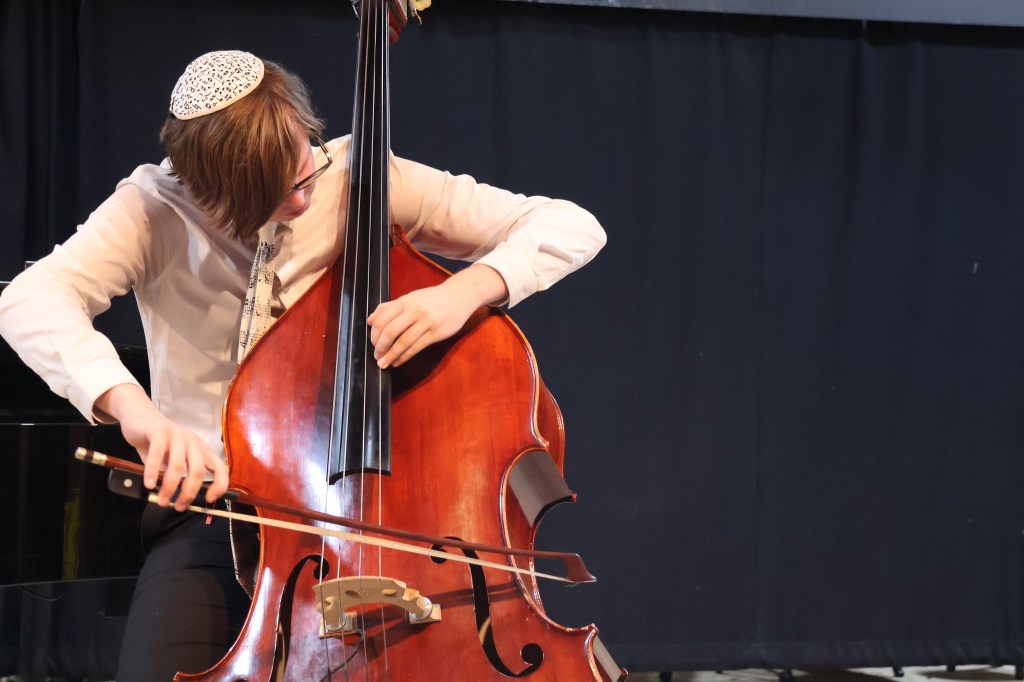
At the end of the 3rd grade my elementary school choir teacher strongly encouraged me to pick up a string instrument.I chose the Double Bass. Unfortunately, the Pandemic struck the very year I picked it up, and I didn’t really start learning how to play until I joined the Middle School Orchestra at Greylock, taught by Patrick O’Connell. After a year, I began to take my instrument more seriously: I applied to the MMEA Western Districts Festival at the highest level my age would allow, and chaired the Double Bass section from 8th grade onward. I received recommendations to audition for the All-State orchestra all years in the Senior Festival, and have applied every year. When I was 14, I started studying with Dorian Jackman, who was my private teacher for two years before he went to Italy. We worked on the classic student repertoire: Capuzzi Concerto in F, Dragonetti Concerto in G, Vivaldi Cello Sonata No. 3 in A minor, Koussevitsky Concerto in E minor, Two Bourrees from Bach’s Cello Suite No. 3, and many others. In the summer leading towards my Junior Year of highschool I began studying with Robert Zimmerman.
In the spring semseter of my 8th grade year I joined CIAO! my local community string orchestra conducted by Jimmy Bergin. CIAO! was my first experience playing in an ensemble that didn’t belong to a classroom. Jimmy recognized that I had talent as a soloist and I began to premiere arrangements and pieces on Double Bass. In 2025 I premiered Amy Reich’s Aega which featured the double bass as the primary melodic instrument, and in 2026 I debuted my own arrangement of Max Bruch’s Kol Nidrei. At the start of my junior year of highschool I started studying conducting with Jimmy, and he helped to prepare me to take the AP Music Theory exam.
Jimmy also encouraged me to audition for ESYO’s 25-26 semester. Neither of us were convinced that I would place, but I won a spot in the top ensemble: Symphony Orchestra, conducted by Etienne Abelin. ESYO Symphony was the most serious ensemble I had played with. A roughly 100 piece orchestra, we collaborated with the Albany Symphony Orchestra and RPI Symphony Orchestra regularly. I played my very first full symphony, Symphony No. 4 by Tchaikovsky, with ESYO and sat second chair. Our end-of-semester piece was Mahler 1, which we played at Carnegie Hall. I auditioned for and won the Double Bass Solo in the third movement.
ESYO is where I played in my first real Chamber Ensemble. Mostly comprised of first and second chair players, my group played the first two movements of Beethoven’s Septet in Eb Major. We regrouped next semester to finish learning and performing the septet, and later made plans to reform next year to play the Schubert Octet, requested by the head music director of ESYO, Etienne Abelin.
Which brings me to today, where I’m currently working hard to become a professional musician. While I don’t know whether I want to become a jazz or orchestral bassist, a contemporary composer, a symphonic conductor, or a music educator, I’m working hard on all aspects of music that I can. I’m looking at schools like the Julliard School, Oberlin, John Hopkins Peabody Institute, Boston University, and McGill, all to pursue a degree in Double Bass Performance.

